

The Study of Falling
"I've fallen and I can get up"
By Neil Ohlenkamp
The most basic, long lasting, and universal of all fears, across all cultures, is the fear of falling. Behavioral research has established that babies are born with only two innate natural fears. One is a fear of loud noises and the other is the fear of falling. Over time people do develop other fears. Many can become critical problems that disable normal functioning. On the other hand, most people can also train to overcome their fears and learn to cope with them. Learning to deal with the fear of falling can establish an important sense of confidence that often will translate into the ability to deal with other fears.
Although the most primal fear we experience is falling, most people have many opportunities to fall and realize at a young age that they can survive. Recreation and sports activities can accelerate that level of acceptance, especially sports that teach you how to fall safely. Activities as diverse as gymnastics, football, hiking, and skateboarding provide plenty of opportunities to fall, but no activity deals with the fear of falling so directly and positively as Judo.
Richard Carlson, author of "Don't Sweat the Small Stuff," defines fear with the acronym False Evidence Appearing Real. In general, fear is an unrealistic expectation of a negative, usually painful, outcome. It is often self-perpetuating and difficult to change. When we fear something we often try to avoid it. Yet we all know that the way to overcome fear is to face it, recognize the damaging effects of fear, and begin a step-by-step process of dealing with it.
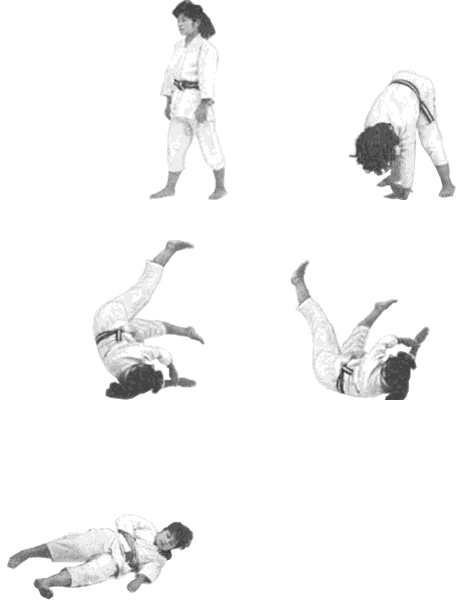 In classes around the world this is typically the first thing Judo
teachers focus on with new students. Before anyone can be expected to
participate in a sports activity involving physical contact or
falling, they should develop certain skills and learn to overcome
their fears so they can feel comfortable falling. Yet Judo is unique
among sports and martial arts in the way it incorporates a scientific
approach to the methods of falling called ukemi.
In classes around the world this is typically the first thing Judo
teachers focus on with new students. Before anyone can be expected to
participate in a sports activity involving physical contact or
falling, they should develop certain skills and learn to overcome
their fears so they can feel comfortable falling. Yet Judo is unique
among sports and martial arts in the way it incorporates a scientific
approach to the methods of falling called ukemi.
It is so important to success in Judo that we practice ukemi not just when we are beginning to learn Judo, but as a part of almost every practice session. Jigoro Kano, the founder of Judo, explains the importance of ukemi this way:
As I have often said if one hates to be thrown, one cannot expect to become a master of the art. By taking throws time after time, one must learn how to take falls and overcome the fear of being thrown. Then one will become unafraid of being attacked and be able to take the initiative in attack. Only by following this manner of training can one learn true Judo technique.
It is not possible to excel in throwing, or to defend against an attack successfully, without a thorough understanding of falling. It is also not possible to be successful in matwork without learning to control the transition from standing to the mat, the very definition of falling.
The traditional order of training is to move from the simple to the more difficult. Each person will progress at their own speed but the basic steps are as follows:
- At first practice falling from a low position, and gradually move higher.
- Learn one direction and style of falling, then learn to fall in other directions.
- First fall in place, then add movement.
- In the beginning move slowly and carefully, then increase speed.
- First fall by yourself, then have a partner throw you. When someone is throwing you, repeat the learning steps 1 through 4 (i.e. start with a low throw, one direction, no movement, and slow speed).
This step-by-step, approach to safe falling sets the stage for developing confidence, coordination, and control. Learning to fall properly and safely can be a big step towards facing some of the other more difficult lessons that come with intense Judo training. In addition, this method of learning will immediately transfer well to the study of your first throws. For example, first learn easy throws, in one direction, without movement, slowly with a cooperating partner. As you master each element then add other directions, movement, resistance, etc.
 Knowing the importance of ukemi, strive to improve your skills.
Challenge yourself by practicing different ways to fall, keeping
safety uppermost in mind. Constantly work on developing a fearless
attitude that will eventually allow you to relax and fully enjoy the
complete Judo experience. You will then discover that your study of falling not only keeps you safe, but makes Judo fun.
Knowing the importance of ukemi, strive to improve your skills.
Challenge yourself by practicing different ways to fall, keeping
safety uppermost in mind. Constantly work on developing a fearless
attitude that will eventually allow you to relax and fully enjoy the
complete Judo experience. You will then discover that your study of falling not only keeps you safe, but makes Judo fun.
Falling is a vital element of the Judo principle of "Mutual Welfare and Benefit." You can only learn throwing techniques with the help of partners who fall. Eventually you will find that becoming an expert in both throwing and falling improves your ability to sense attacks early so you can avoid, stop them, or use them to your advantage. This is why Judo experts become practically impossible to take down and are never afraid.
 Return to the Encino Judo Club
This page is copyright © 2001/2026 by Neil Ohlenkamp, JudoInfo.com. All rights reserved. Published March 1, 2001. Last updated January 18, 2026.
